Consultation tools for health workers with basic handsets and no reliable signal
Context
Community health workers in Malaba serve patients who live hours from the
nearest facility. The workers are not clinicians. They assess, advise, refer,
and follow up, and until this programme they did all of it from memory and on
paper.
The constraint that shaped everything: most of them did not have a smartphone,
and where they did, signal was intermittent. An app was not an option. Whatever
we built had to run on a handset with a numeric keypad and a two-line display,
in places where a session could drop halfway through a consultation.
Starting position
A consultation left no durable record. What the worker asked, what they advised
and what they promised to check next existed in a notebook, or in their memory,
or nowhere at all.
Three failures followed from that. Assessment varied by worker, because nothing
prompted the same questions in the same order. Follow-ups were lost, because
nothing tracked what was owed to whom. And escalation had no path: a worker who
met a case beyond their competence had no route to hand it upward that was
faster than travelling.
Constraints
Decisions
01
One information architecture across three channels, not three products
Problem
SMS, USSD and IVR have opposite interaction models: one is asynchronous text, one is a synchronous menu tree, one is voice. Designed separately they would drift, and a worker moving between them would face three different mental models of the same task.
Response
The channels were designed against a single architecture. The same consultation has the same stages, in the same order, whatever the channel carries it, so what a worker learns once transfers.
Traded away
Each channel is less idiomatic than it could have been alone. The USSD menus are shallower than USSD alone would allow, and the IVR tree is more rigid, because both answer to a shared structure.
02
USSD as the spine, with the protocol carrying the questions
Problem
Assessment varied by worker because nothing prompted a consistent sequence. Training alone does not fix that: it decays, and it decays fastest under pressure.
Response
The consultation runs as a guided sequence on USSD, reached through a short code. It takes the patient identifier, presents the symptom areas, and walks the protocol question by question to a recommendation and a referral decision. The structure asks the questions rather than relying on the worker to remember them.
Traded away
A guided sequence is slower than a worker who already knows what to ask, and it constrains judgement in cases that do not fit the protocol.
03
Language chosen before anything else on the voice channel
Problem
A worker who reads with difficulty is not served by a text menu, and a health instruction delivered in a second language is a clinical risk, not a preference.
Response
The IVR flow opens with language selection across English, Kiswahili and Luhya, before authentication or any menu. The channel exists to serve the workers text excludes, so the first thing it does is remove the language barrier.
Traded away
An extra step at the start of every call, on the slowest channel, paid by every user including those who would not have needed it.
04
SMS carries what must survive a dropped session
Problem
Reminders and follow-ups are exactly the things that were being lost, and they are the things a synchronous channel cannot guarantee: if the session drops, an interactive prompt is simply gone.
Response
Appointment reminders, follow-up prompts and health guidance go out over SMS. They arrive without a session, they persist on the handset, and they can be read when signal returns rather than when it happens to be present.
Traded away
One-directional and character-limited. A reminder can be delivered but not negotiated, so anything needing a reply has to hand back to another channel.
05
A consultation can start on one channel and finish on another
Problem
Treating each channel as its own silo means a dropped USSD session restarts from nothing, and the worker pays for the network's failure with the patient's time.
Response
Interactions record against the same patient record regardless of the channel that produced them, so a consultation interrupted on one channel can be resumed rather than repeated.
Traded away
Cross-channel state is the most complex part of the system and the least visible to the user. It carries integration cost that a single-channel design would never have paid.
Flow
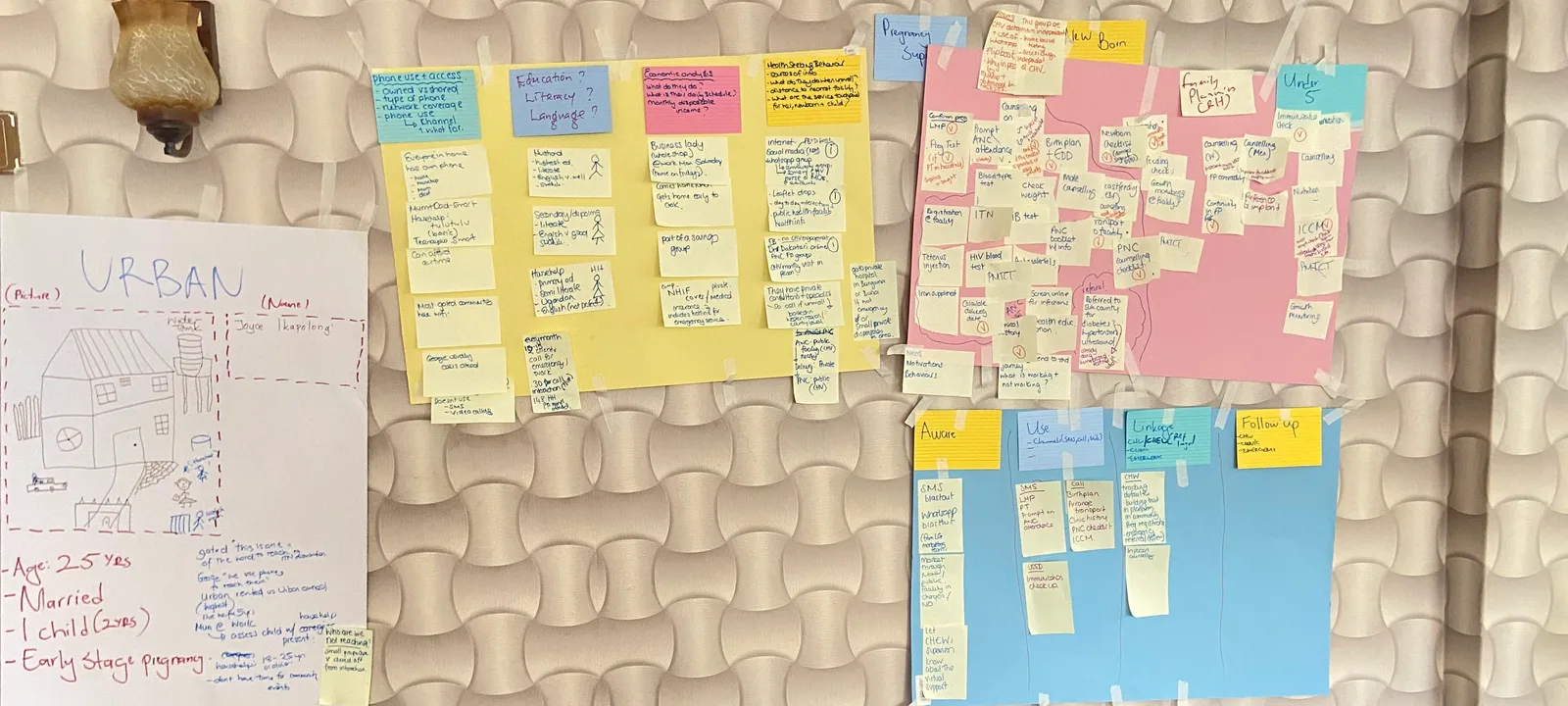
Segmenting the population the workers serve, into urban, peri-urban and
rural. The two constraints this project turned on are columns of enquiry on
the yellow board: what phone somebody has and whether they share it, and what
they read and in which language. The channel decisions further up rest on what
was written on these notes.
Outcome
The programme ran from April to November 2023 in Malaba. We onboarded more than 15 community health workers who had never had consultation tooling, and 75% of them were still using it at the end of the programme. That figure comes from Living Goods' programme records, confirmed by my supervisor at the time.
Clinical outcome figures aren't included here. The programme measured them, but I don't have a record I can point to.
Honest limits
The retention figure is the only outcome number on this page, and it's small by design. Fifteen-odd health workers is a pilot, not a rollout. It shows the tooling held up in daily use. It doesn't show what happens at a few hundred workers, where training, support and network cost behave differently.
Two further limits worth stating. I was Project Manager as well as designer on
this programme, so the design decisions and the delivery decisions were not
independent of each other. And the work was designed for one district: nothing
here has been tested at the scale the reported figures implied.
Next
The channel architecture is the part worth carrying forward. Where it should be
tested next is against a population with different literacy and language mix,
because the three-channel split was fitted to Malaba's, and it is the assumption
most likely to break somewhere else.